Bhikkhu Dhammasami Chanting is very common to any religion. Buddhism is no exception in this regard. However, the aim and purpose of chanting is different from one religion to another. Buddhism is unique in that it does not consider chanting to be prayer.
The Buddha in many ways has shown us to have confidence in our own action and its results, and thereby encouraged us to depend on no one but ourselves. This in fact is the sum and substance of His last message in the Mahaparinibbana Sutta. One of the passages in this discourse reads: "Ananda, be dependent on yourself, take refuge in yourself and not in others, by this mean be dependent on the Dhamma, go for refuge to the Dhamma -- the righteous principles".
When a Buddhist does chanting, he is not asking some one to save him from evil nor is he hoping to be given a place in heaven as a result after he dies. Instead, through chanting he may be learning, teaching, philosophising or re-memorising the discourse.
Actually, in the Anguttara Nikaya there are some discourses dealing with chanting like Dhammavihari Sutta. It mentions five categories of people who make use of the discourses.
The first one studies it just for the sake of study without putting it into practice or explaining it to others. He even does not reflect deeply on what he has studied. He is known as 'Pariyatti-bahulo' who is keen on studying it alone.
The second one preaches or teaches what he has learnt from the discourses but does not follow it himself. He is 'Pannyatti-bahulo' who is keen only on teaching.
The third one does chanting. He philosophises about the discourses, trying all the time to satisfy his philosophical thirst. He forgets to make use of as mode or life. He is called 'Vitakka-bahulo' who is eager only to indulge in philosophical aspects of the Suttas (Discourses).
The fourth one is the one who chants the discourses to make them last for a long time in his memory. He memorises and re-memorises. Nevertheless, he does not go further to follow it in daily life. He is 'Sajjhayaka-bahulo' who is enthusiastic only in memorising or chanting the teachings of the Buddha, He may even expect some magical power from chanting.
The fifth and last one is one who studies the discourses, teaches them to others, reflects on their philosophical points, chants them regularly and above all actually practices it in daily life. He is the one the Buddha praises to be 'Dhammavihari' -- a practitioner of the Dhamma, which he has learnt from the discourses.
Having reflected on this Sutta, it is left to us to judge ourselves to which category we belong and why we study or chant the discourses.
I would like to dwell a bit more on chanting in general. This is, after all, an All-night Chanting ceremony. It is nothing but right for us to be fully convinced of what we are doing. Initially I did mention that Buddhism is unique because it does not consider chanting to be a form of prayer.
Then why do we, Buddhists, chant?
In the olden days, before there were sufficient support materials for study like books, translations and computers we had to memorise to learn a discourse. After we had learnt it, we still had to chant regularly to protect it and hand it down to future generations. If we did not recite it daily we might forget it and omit some part of it. The Anguttara Nikaya says that if the discourses are poorly maintained this will lead to the disappearance of the Sasana.[1] It was so important those days to memorise and chant it regularly. This must have definitely contributed in developing chanting practice. Chanting meant almost for the survival of the Dhamma itself.
Now we have sufficient support materials, why we should then be still chanting? Is there any more reason to do this?
There are some reasons sufficient to continue chanting practice. Regular chanting gives us confidence, joy and satisfaction, and increases devotion within us. This devotion is really a power. It is called the Power of Devotion (Saddhabala). It energises our life in general. I do not know about the others. For me I often have a joyous feeling when the chanting goes right. I become more confident of myself. I see it as a part of developing devotion.
In Buddhist monastic education tradition, chanting and learning by heart still forms a part of it. We study some of the Theravada Abhidhamma texts -- the highest teachings of the Buddha which deal with the ultimate nature of things -- in that way in Burma. We are explained the meaning and how the logic develops in the Abhidhamma. In the night we try to chant without having learnt it by heart. We could do it because of the technique. It is known as evening-class (nya-war) over there. It means a certain technique of studying the Abhidhamma and some of the Suttas. It is very helpful as it helps you to reflect very quickly.
When we examine the nature of the discourses, the reasons for chanting will become clearer to us than ever.
THE NATURE OF THE DISCOURSES
A Sutta (Discourse) like Mangala Sutta was an answer to the Deva who asked the Lord Buddha about the real progress in social, economic and spiritual life. It is the vision of the Buddha on those issues as much as his advice to all of us who genuinely want those progresses in social and spiritual life. It is some thing that we should follow throughout our life starting from childhood to the day we take our last breath. Most of the Suttas are of this nature. They are descriptions as well as prescriptions for the common diseases like Lobha, Dosa and Moha (Greed, Hatred and Delusion).
Another nature of the discourses is protection or healing. Ratana Sutta is one of the best-known examples here. It was first taught to Venerable Ananda who in turn chanted in Vaisali to ward off all the evils and famine the people were then facing. Angulimala Sutta also falls into this category as it relieves the pains and trouble of a would-be mother. Mahasamaya Sutta and Atanatiya Sutta come under the same category because they emphasise much on protection and healing. Remember that Venerable Ananda and Venerable Angulimala did cultivate love and compassion before they chanted the discourse for this particular kind of blessing.
The three Bojjhanga Suttas [2] (Maha Kassapa/Moggallana/Cunda) [3] have been in common use to help relieve the suffering of a patient. This is the third nature of the discourses I am trying to understand and reflect.
Even the Buddha asked Venerable Cunda to chant this Bojjhanga Sutta when He was ill. He himself did the chanting of the Bojjhanga Sutta when his senior disciples, Venerable Maha Kassapa and Venerable Maha Moggallana, were sick. These are the kind of Suttas that have both instructions for meditation practice and healing power. Karaniyametta Sutta has these same natures: instruction for daily practice to develop our spiritual benefit and to ward off the evils.
In other words, Buddhist chanting serves as a reminder of the practice we need to follow in daily life. If we understand and learn how to do it properly, it is another type of meditation in itself. It is also at the same time a healing or blessing service.
The last benefit we may get from chanting discourses is meditative one. When we chant if we try to concentrate well on the chanting, our mind becomes contemplative, not wandering, not engaging in unwholesome thoughts. The late Venerable Dr. H. Saddhatissa Mahanayaka Thero, the founder of SIBC [4], has rightly remarked in his work [5] that almost all Buddhist practices are nothing else but some form of meditation.
 Washing bottles. First wash with chlorine, second wash with salt
 Filling up washed bottles with filtered water and capping.
 Tying the bottles with 3 yellow strings each.
 Packing
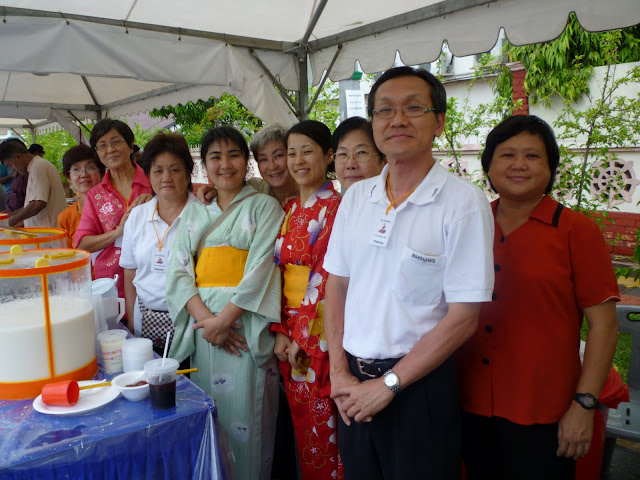
 A group shot of volunteers remaining after the cleanup on the final night.